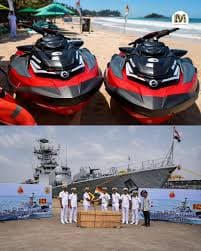
Indian Navy and Indian Coast Guard have handed over two jet skis with safety equipment to Sri Lanka
The Indian Navy and Indian Coast Guard have handed over two jet skis with safety equipment to Sri Lanka
In a move that underscores growing maritime cooperation in the Indian Ocean region, the Indian Navy and the Indian Coast Guard have handed over two jet skis, along with essential safety equipment, to Sri Lanka. This gesture reflects the shared commitment of both nations to strengthen search and rescue (SAR) capabilities and enhance operational coordination in regional waters. Sri Lanka, strategically located along some of the world’s busiest maritime routes, plays a vital role in ensuring the safety and security of sea lanes in the Indian Ocean. With increasing maritime traffic, the need for rapid-response assets has become more important than ever. Jet skis, while compact, are highly effective in nearshore and emergency scenarios, offering speed, agility, and ease of deployment. These qualities make them particularly valuable in search and rescue missions, especially in shallow waters or areas that are difficult for larger vessels to access. The addition of these jet skis is expected to significantly improve Sri Lanka’s ability to respond swiftly to maritime emergencies. Whether it involves assisting distressed fishermen, responding to boating accidents, or supporting disaster relief operations during floods and storms, such equipment can make a crucial difference in saving lives. The inclusion of safety gear further ensures that rescue personnel can operate efficiently while minimizing risks during challenging conditions at sea. This initiative also highlights the deepening defense and security partnership between Sri Lanka and India. Over the years, India has consistently supported Sri Lanka through capacity-building efforts, including training programs, equipment donations, and technical assistance. The handover of these jet skis builds on that foundation, emphasizing practical cooperation that directly benefits maritime safety and humanitarian response. Beyond immediate operational advantages, the move carries broader strategic significance. Maritime security today is not limited to traditional defense concerns; it encompasses issues such as illegal fishing, human trafficking, smuggling, and environmental protection. By strengthening Sri Lanka’s rapid-response capabilities, India is contributing to a more secure and resilient maritime environment in the region. This aligns with broader regional frameworks that encourage collaboration and shared responsibility among neighboring countries. Furthermore, joint efforts in search and rescue operations foster greater interoperability between the two nations’ maritime forces. Regular interaction, training, and the use of compatible equipment enhance coordination during real-life emergencies. Such cooperation is essential in a region where timely response can prevent minor incidents from escalating into major crises. For Sri Lanka, the acquisition of these jet skis comes at a time when strengthening maritime infrastructure is key to supporting economic recovery and safeguarding coastal communities. Fisheries, tourism, and shipping all depend on safe and well-monitored waters. Enhanced SAR capabilities not only protect lives but also build confidence among those who rely on the sea for their livelihoods. The handover of two jet skis and safety equipment by the Indian Navy and Indian Coast Guard represents a meaningful step in advancing maritime cooperation between India and Sri Lanka. It is a practical and symbolic gesture that reinforces mutual trust, strengthens regional security, and highlights the importance of collaboration in addressing shared challenges at sea.